
healing through play
Children don't always have the words — but they always have a way. Play therapy meets them where they are.
what is play therapy?
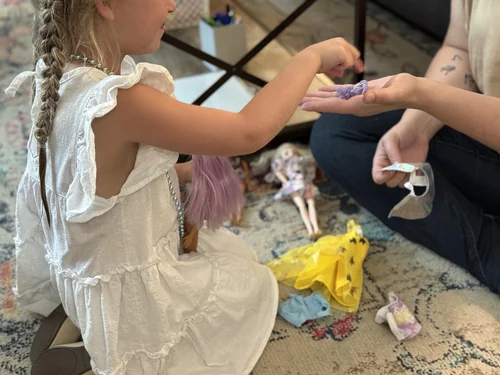
Play Therapy is an innovative way to work with children — usually ranging in ages between three to twelve years of age — to help them better express themselves, their feelings, and resolve problems they are currently struggling with. Play Therapy can also be helpful in working with teenagers, as there are many different approaches that can be adapted for older youth.
It helps children let their guard down. They don't feel the pressure to just sit and talk. Instead, they get to do it on their terms, in their own way — and that makes all the difference.
Play therapy provides a safe space for children to work with their therapist one-on-one in a more natural setting, so they can learn about emotions, what they are feeling, how to process those feelings, and implement coping mechanisms.
Please note: Dragonfly Counseling does not see children under the age of 4 at this time. If you are interested in family counseling for younger children, please contact our office to discuss options.
what it can help with

the benefits
Children learn to identify and express their emotions in healthy, constructive ways — and discover that all feelings are valid and okay.
Children develop creative problem-solving skills and practical coping tools they can use both in and outside of sessions.
Through the therapeutic relationship and play, children build self-esteem, self-reflection, and a stronger sense of who they are.
Play therapy helps children develop empathy, stronger social skills, and the ability to build and maintain meaningful relationships.
In a safe, non-threatening environment, children can explore fears and worries at their own pace — reducing anxiety over time.
When appropriate, parents and siblings are included in the process — improving family understanding, dynamics, and healing together.
for parents
Bringing your child to therapy can feel like a big step, and it's natural to have questions. Here's what you can expect at Dragonfly Counseling:
For children under 10, our intake process includes two separate components designed to support comfort and accurate assessment:
- 30-Minute Child Play-Based Observation Consult — the clinician gently observes the child's behavior, play themes, emotional responses, and interaction style. This is a relational and observational tool, not a formal diagnostic assessment.
- 60-Minute Parent Intake Session — a dedicated session with parents or guardians to gather developmental history, family background, presenting concerns, and treatment goals.
For clients over the age of 10, our intake process follows the standard approach, which allows the client to express autonomy over the therapeutic process. If a parent requests a different approach — such as a joint intake or a parent-only intake first — we will accommodate this preference when clinically appropriate.
Ongoing parent consultations are an essential part of treatment for many child and adolescent clients. These sessions may be used to discuss progress or concerns, review parenting strategies, address school or family dynamics, and coordinate care with other professionals. Parent consults are scheduled separately from your child's regular session on a needs-based basis.
We take consent and confidentiality seriously and honor our ethical and legal responsibility to respect minor consent laws in Washington and Idaho. We work to maintain a safe, trusting space for your child while keeping you appropriately informed about their care.
important to know
When working with children of divorced, separated, or non-cohabitating parents, we follow all applicable legal and ethical guidelines:
- We require copies of current legal custody documentation before initiating treatment.
- In shared custody situations, both legal guardians need to provide consent for services and sign Dragonfly's Informed Consent, unless one parent has sole legal custody.
- Clinicians are not able to provide legal opinions or make custody recommendations — doing so would violate professional ethics and scope of practice.
- Disputes about access, involvement, or records must be resolved through legal channels. We aim to remain neutral and focus solely on the therapeutic best interest of the child.
- If custody conflicts interfere with treatment, we may pause or decline services until the legal situation is clarified to protect the emotional well-being of the child and the integrity of the therapeutic relationship.
at dragonfly
Sidney specializes in working with children and teens using play therapy interventions, mindfulness practices, and EMDR. She is especially passionate about working with neurodiverse clients and providing affirming care to queer youth.

learn more
To learn more about Play Therapy, visit the Association for Play Therapy: